The Strongest Fiber
How platinum-rhodium tooling, surface chemistry and draw continuity turned molten glass into the structural material of wind power and electronics - Part of the Glass series

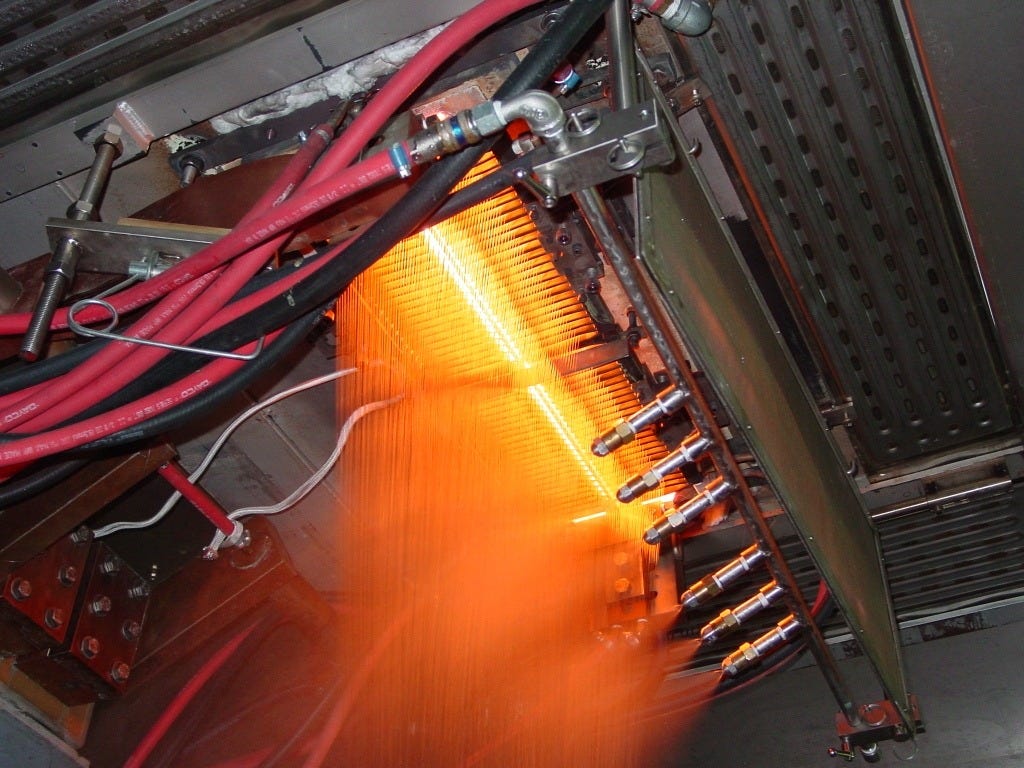
Continuous glass fibre is drawn through platinum-rhodium bushings, electrically heated plates with hundreds or thousands of tips, built from an alloy so valuable that the workshop where they are constructed and repaired operates behind security doors with restricted access. Everything that enters and leaves is weighed and logged. Every particle of platinum dust is recovered. When Owens Corning sold its glass reinforcements business in 2026, it expected fifty to seventy million dollars from excess platinum-rhodium alloy alone, not the business, not the equipment, just the metal inside the tooling. These are not laboratory instruments. They are industrial tools, and they sit at the most critical point in the production of a material that reinforces wind turbine blades, printed circuit boards, automotive panels, pipes, tanks and most of the composite structures the modern economy depends on.
Glass fibre production follows a physical sequence unchanged in principle since Owens-Corning Fiberglas Corporation commercialised the process in 1938. Molten glass flows through a heated platinum plate, is drawn into filaments thinner than a human hair, coated with sizing, gathered into strands, wound into forming packages, dried, cured, and converted into the product forms industry buys. What has changed in nearly ninety years is the scale, speed, chemistry, and precision of every step, but the sequence remains the same. Walking through a modern plant from one end to the other remains the clearest way to understand it.
What glass fiber is
E-glass is the workhorse, a calcium-aluminosilicate glass, roughly 52 to 62 percent silica, 12 to 16 percent alumina and 16 to 25 percent calcium oxide, with a tensile strength about six times that of structural steel. It dominates global production by volume, but much of it has become a commodity whose manufacturing migrated to China on cost and scale. The higher-value shift came from composition. In 1997, Owens Corning introduced Advantex, a boron-free E-glass that eliminated boron and fluorine emissions from the furnace and improved corrosion resistance. Owens Corning has since converted all of its North American production to boron-free glass. The boron-free segment reached an estimated 1.2 billion dollars in 2024 and is growing at roughly ten percent per year. But the shift away from boron applies only to structural and corrosion-resistant applications. In electronics, the story is the opposite. For electronic-grade fibre, the kind laminated into printed circuit boards, boron is still required because dielectric properties depend on it. And as circuits push toward higher frequencies for 5G and high-speed computing, the trend in electronic glass runs further still: D-glass formulations carry twenty to twenty-five percent boron oxide, far more than standard E-glass, because a lower dielectric constant means less signal loss.
S-glass uses a simpler silica-alumina-magnesia composition with no boron oxide. It is roughly forty percent stronger than E-glass and significantly stiffer, closer to carbon fibre in performance, though still well below it. The premium over E-glass restricts its use to aerospace, military and high-performance composite structures where weight savings justify the cost.
The rest of this article is available to paid subscribers.
What follows:
A walk through a glass fibre plant, from batch house to warehouse, the full process, zone by zone
Who controls three-quarters of global production capacity
Where the fibre goes, from wind blades to printed circuit boards
