
ASML: The Supply Chain Behind the EUV Machine
The companies, the sites and the parts inside the only machine that prints advanced chips

Air and glass absorb light at 13.5 nanometers. For that reason, an EUV lithography machine works in vacuum and uses mirrors instead of lenses. Those mirrors collect light from the source, shape it, and project the circuit pattern of the mask onto the wafer at a fraction of its original size. This process takes about eleven reflections, and each mirror returns at most 70 percent of the light that hits it. So only a small fraction of the energy generated at the source reaches the silicon. Every component in the machine is designed around that constraint.
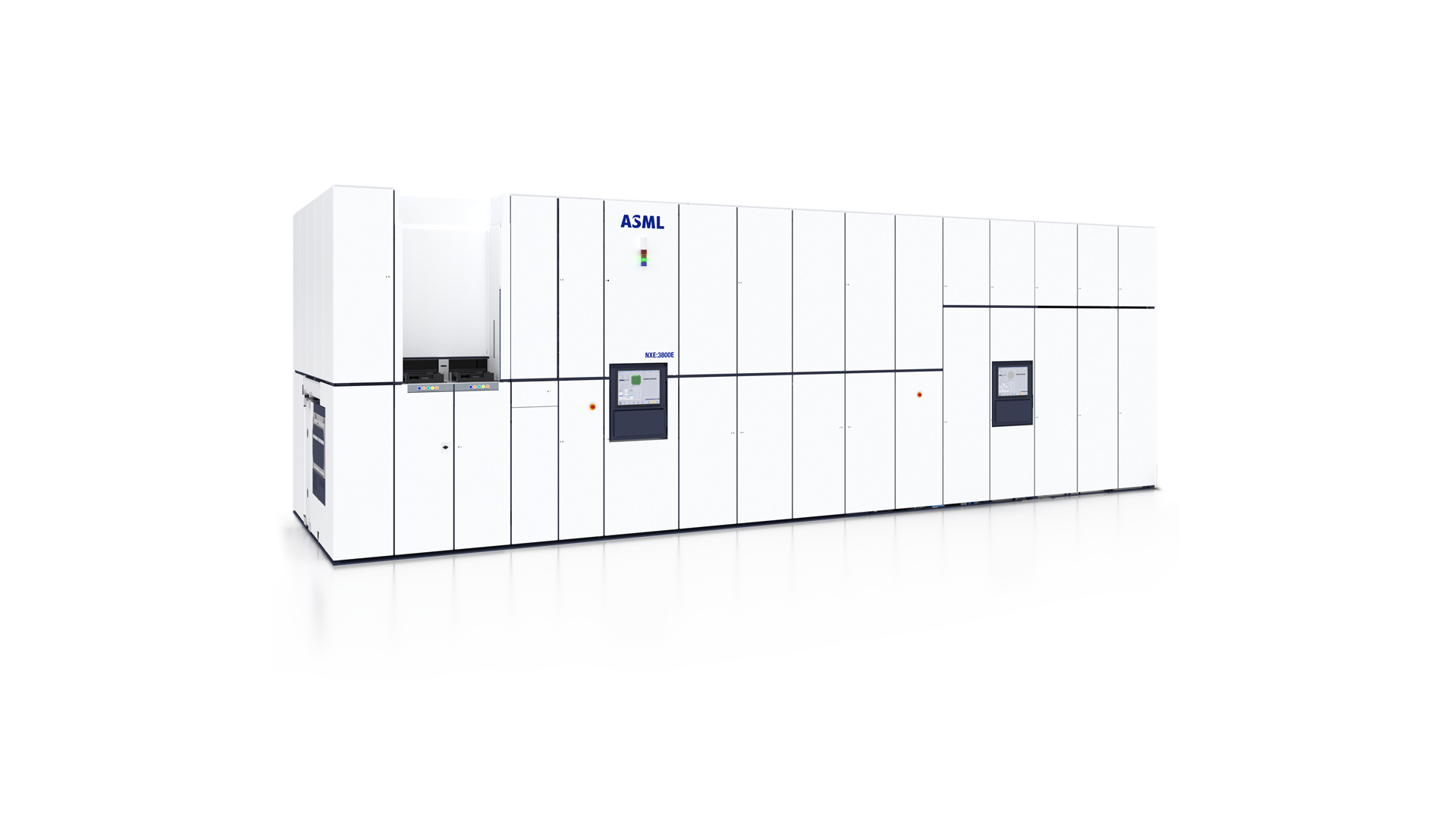
ASML, based in Veldhoven in the Netherlands, is the only company that builds this machine. In 2025 it delivered 48 EUV systems within total sales of €32.7 billion, and its annual report counts 5,100 suppliers behind that output. ASML describes its own role as architect and integrator, since most of the parts and modules come from outside. For the hardest parts there is exactly one qualified supplier each, and this article goes through them one by one.
The integrator
ASML was founded in 1984 as a joint venture between Philips and ASM International, a Dutch maker of chip production equipment, and started in temporary buildings next to a Philips lab in Eindhoven. Its Japanese competitors, Nikon and Canon, made their own lenses and much of their own hardware, while ASML had no capital for that. Instead, it sourced lenses, motors, and stages from outside companies and focused on system design and integration. Four decades later, it still assembles every machine in Veldhoven from parts mostly arriving from elsewhere.
EUV technology itself has American roots. Three US Department of Energy national laboratories, Lawrence Livermore, Sandia and Lawrence Berkeley, carried out the foundational research under a roughly $250 million program funded from 1997 by an Intel-led industry consortium, and that work produced the first full-field EUV prototype in 2001. ASML joined the consortium in 1999, and in 2001 it bought Silicon Valley Group, the last American lithography maker, for about $1.6 billion, gaining the US research and manufacturing base it still runs in Wilton, Connecticut.
By 2012 the cost of developing EUV had grown beyond what ASML could fund from its own revenue, so its three largest customers stepped in. Intel, TSMC and Samsung together bought a 23 percent stake for €3.85 billion and committed a further €1.38 billion to ASML’s research programs. Their own product plans by then depended on a machine that did not yet work.
Carl Zeiss SMT — Oberkochen, Germany
As an integrator, ASML depends on a handful of critical suppliers, and the first of them is Carl Zeiss SMT in Oberkochen, a town of about 8,000 people in Baden-Württemberg, which makes the optics. Since ordinary lenses absorb EUV light, Zeiss builds mirrors for these machines. Each mirror carries up to 100 alternating layers of molybdenum and silicon, every layer a few nanometers thick, stacked so that the weak reflections from all the layers add up into one usable beam. One layer alone would return around one percent of the light; only the full stack reaches the reflectivity the machine is designed around.
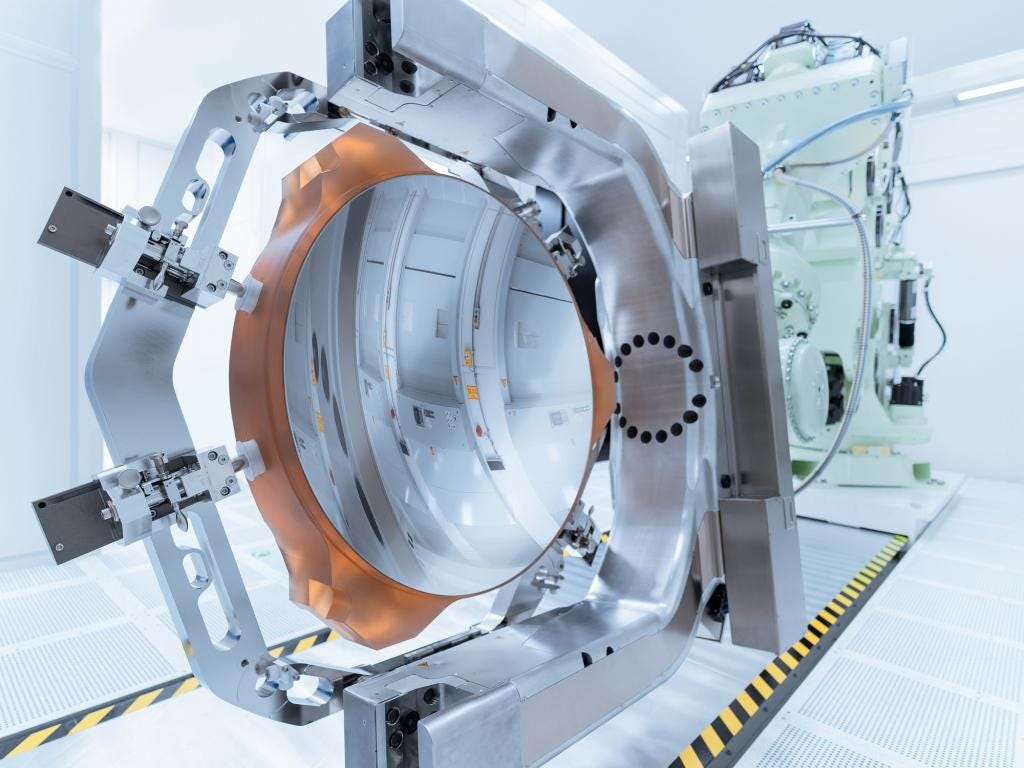
Under the coating, the mirror surface is polished to a precision Zeiss describes with a comparison it has used for years: scaled up to the size of Germany, the largest unevenness would stand a tenth of a millimeter high. Final correction is done by ion beam figuring, which removes material from the surface atom by atom. A standard EUV mirror takes months to produce, and the larger mirrors for the new High-NA generation take around a year each.
In 2016 ASML bought a 24.9 percent stake in Carl Zeiss SMT and put additional money into Zeiss R&D and capacity, with one goal: getting the High-NA optics built. The majority of the company stayed with Zeiss, so the deepest dependency in the machine remains an outside relationship.
